M3 Memory Models
Notes from:
Memory model decides the visibility and consistency of changes to data stored in memory. The hardware’s memory model helps developers understand what the hardware guarantees.
M3.1 Sequential Consistency
Essentially, if processors are running instructions
-
The order of instructions that a processor runs cannot be re-ordered. i.e. if a processor has instructions
I1, I2, I3, they must be applied in the same order. -
Instructions accross processors can interleave in any way while the condition
1is not violated
Mental model: Threads write to a shared memory, without any caches. Only one thread is allowed to read/write at a time.

M3.2 x86 Total Store Order (x86-TSO)
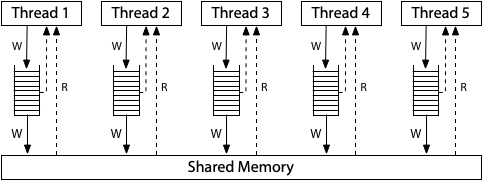
All threads are connected to a shared memory, but:
- each processor queues writes into a local write buffer
- each checks local write buffer before checking the shared memory.
- i.e. a processor sees it writes before others do
- All processors agree on the total order of writes to the shared memory.
- corollary: If we have N reader threads and 1 writer thread, then all the readers MUST see the written value together. i.e. either they all see the old value or all see the new value.
M3.4 ARM Relaxed Memory Model
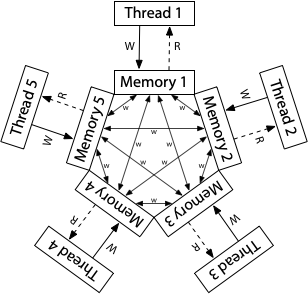
- Each processor reads/writes to its own copy of memory.
- The writes are propagated to other threads independently. Writes can propagate with any reordering.
- But write order is agreed by all the Threads. (i.e. it may happen at different times, but the order is the same)
- Each thread can also postpone a read until after a write. i.e. reordering within a thread’s instructions.
M3.4 Litmus tests
A series of tests to show cases where the memory models differ. In each test, threads read/write to shared values x,y,z… and read to thread local registers r1,r2,…
M3.4.1 Litmus test: Message Passing
// Thread 1            // Thread 2
x = 1                     r1 = y
y = 1                     r2 = x
Q. Can this program see r1=1 and r2=0?
- Seq Consistency: NO
- because writes in Thread 1 must happen in the same order
- TSO: NO
- writes queue guarantees the x write happens before y write.
- ARM: YES
M3.4.2 Litmus test: Write Queue
// Thread 1            // Thread 2
x = 1                     y = 1
r1 = y                    r2 = x
Q. Can this program see r1 =0 and r2 = 0?
- Seq Consistency : NO
- read to registers can only happen after atleast one of x or y are written.
- TSO: YES
- if x and y writes are still in the queue, both processors can read old values.
- ARM: YES
M3.4.3 Litmus Test: Independent Reads of Independent Writes (IRIW)
// Thread 1      // Thread 2      //Thread 3      //Thread 4
x = 1            y = 1            r1 = x          r3 = y
                                  r2 = y          r4 = x
Q. Can this program see r1=1, r2=0, r3=1 and r4=0 ?
- Seq Consistency: NO
- writes to x and y must be appear to all threads in same order.
- TSO: NO
- write order is agreed by all processors
- ARM: YES
M3.4.4 Litmus Test: n6 (Paul Lowenstein)
// Thread 1         //Thread 2
x = 1               y = 1
r1 = x              x = 2
r2 = y
Q. Can this program see r1=1, r2=0 and x=1 ?
- Seq Consistency: NO
- TSO: YES
- x =1 is written, but y=1 and x=2 are still in the write queue.
- ARM: YES
M3.4.5 Litmus Test: Load Buffering
// Thread 1         // Thread 2
r1 = x              r2 = y
y = 1               x = 1
Q. Can program see r1=1, r2=1?
- Seq Consistency: NO
- TSO: NO
- ARM: YES (can reorder reads)
M3.4.6 Litmus Test: Store Buffering
// Thread 1            // Thread 2
x = 1                  y = 1
r1 = y                 r2 = x
Q. Can the program see r1=0, r2=0?
- Seq Consistent: NO
- x86 TSO: YES
- ARM: YES
M3.4.7 Litmus Test: Coherence
//Thread 1        //Thread 2        //Thread 3        //Thread 4
x = 1             x = 2             r1 = x            r3 = x
                                    r2 = x            r4 = x
Q. Can the prohram see r1=1, r2=2, r3=2, r4=1 ?
- Seq Consistent: NO
- x86 TSO: NO
- ARM: NO
M3.5 Weak Ordering and Data Race Free Seq. Consistency (DRF-SC)
- Proposed by Sarita Adve and Mark Hill in “Weak Ordering – A New Definition”.
- synchronization model : a set of constraints on memory accesses to specify how & when synchronization needs to done
- Hardware is weakly ordered w.r.t. a sync model IFF it appears seq. consistent to all software that obeys the sync. model.
- One model that was proposed by the authors is Data-Race-Free (DRF) model.
- DRF assumes HW has sync operations, other than read/write.
- a barrier is a sync-operation
- Then read/writes can be reordered but cannot be moved across a sync-operation.
- DRF assumes HW has sync operations, other than read/write.
- A program is DRF if two memory accesses are:
- either both reads
- Or accesses that are separated by sync operations, forcing one to happen before the other
- Weak Ordering: A contract between SW and HW that If SW is DRF, the HW acts as if it is sequentially consistent. This was proved by the authors
- A recipe for HW designers & SW developers to run sequentially consistent programs.